
The top three fixed line players Bharat Sanchar Nigam Limited, Mahanagar Telephone Nigam Limited and Bharti Airtel reported a revenue decline.

Telcos in Asia's emerging markets will face higher spectrum liabilities, but these essential costs are not subject to refinancing and have limited immediate impact on cash flows and liquidity, Moody's Investors Service said on Monday. The ratings of Asia-Pacific (APAC) telecom companies in emerging markets can tolerate the increased deferred spectrum liabilities at current levels, if these essential costs are the main driver of high debt or weaker leverage, Moody's Investors Service said in a new report. For emerging markets -- China, India, Indonesia, Malaysia and Philippines -- spectrum liabilities to gross debt will increase to more than 16 per cent in 2021 and 2022, from 11.6 per cent in 2020 and 9.3 per cent in 2018, assuming India completes its 5G spectrum auction in 2022, it added.

Benchmark stock indices Sensex and Nifty rebounded to close over 1 per cent higher on Thursday, propelled by buying in index majors Reliance Industries, HUL and Infosys along with an overall positive trend in global markets. The 30-share BSE benchmark jumped 701.67 points or 1.23 per cent to end at 57,521.06. During the day, it zoomed 971.46 points or 1.70 per cent to 57,790.85 on the expiry of derivatives contracts. The NSE Nifty rallied 206.65 points or 1.21 per cent to 17,245.05.

Benchmark BSE Sensex rose by over 379 points on Tuesday as gains in oil & gas, banking and auto shares helped the barometer continue winning run for the third straight session. The 30-share BSE benchmark index advanced 379.43 points or 0.64 per cent to settle at 59,842.21. During the day, it jumped 460.25 points or 0.77 per cent to 59,923.03. The broader NSE Nifty climbed 127.10 points or 0.72 per cent to 17,825.25 as 42 of its constituents advanced.

ICICI Bank was the top gainer in the Sensex pack, rising around 4 per cent, followed by UltraTech Cement, Sun Pharma, Bharti Airtel, HUL, SBI, L&T, Axis Bank and IndusInd Bank. On the other hand, Reliance Industries, Bajaj Finserv, HCL Tech and HDFC were among the laggards.
The government is likely to get about Rs 24,000 crore from one-time spectrum fee that has been levied on existing operators for holding radiowaves beyond a prescribed limit.

Gaurav Devaras, a 3G mobile broadband user, is happy to learn about the 4G service launch in Kolkata and thrilled about the speed it can offer.
Trai has said the three operators were "intentionally denying and delaying" the provision of points of interconnects (PoIs) to Jio, "only to restrict a new entrant thus violating the terms and conditions of licence and regulations of the Authority which also caused a lot of inconvenience to the consumers."
The telecom regulator had suggested imposition of a price on operators for holding spectrum beyond the contracted limit of 6.2MHz.

Historically, public sector units were conceived of under the assumption that they will control the 'commanding heights' of the Indian economy, which were necessary for rapid industrial growth but where private investment was unwilling to enter.
Thirty stocks from various sectors form the Sensex.
Cellular major Airtel would be offering its services in Jammu and Kashmir by June next year thus becoming the first private sector operator to enter the militancy-affected state.

Benchmark equity indices Sensex and Nifty rallied for a third day in a row on Wednesday on buying in Reliance Industries, Infosys, HDFC twins and ICICI Bank following gains in global equities amid hopes of a breakthrough in Russia-Ukraine peace talks. The 30-share BSE barometer index surged 740.34 points or 1.28 per cent to settle at 58,683.99. During the day, it jumped 784.13 points or 1.35 per cent to 58,727.78. Similarly, the broader NSE Nifty climbed 172.95 points or 1 per cent to settle at 17,498.25. Among the 30-share pack, Bajaj Finserv, Mahindra & Mahindra, Bajaj Finance, Power Grid, HDFC, ICICI Bank, Nestle, Maruti, Reliance Industries Limited were among the lead gainers. On the other hand, ITC, Tata Steel, Tech Mahindra, Bharti Airtel and Titan were among the laggards.
Telecom watchdog sought the regulator's intervention on the price hike by Bharti Airtel, Vodafone Essar and Idea and alleged that the three telcos have formed a cartel and increased local call charges by 20 per cent.

Reliance-Google's new smartphone has got mixed reviews from analysts and brokerages. The phone pricing is seen unattractive for low-end customers and bundled offers are being viewed as non-disruptive. While this could slow the pace of adoption, it could set the stage for tariff hikes in the industry, feel analysts.

The stock exchange on which they are traded boasts higher profits than most of the companies whose shares are hitting new highs. Only 37 of approximately 2,000 listed companies with comparable data for 2022-23 (FY23) reported higher profits, while the rest had lower profits. Despite rising corporate profitability, the universe of companies that outperform the National Stock Exchange (NSE) in terms of profitability has been shrinking of late, according to an analysis of companies with comparable data over the past seven years.
Mukesh Ambani-led Reliance Jio has introduced a 20-per cent cashback offer on select prepaid plans, intensifying competition in the Indian telecommunications (telecom) market. Jio is the largest telecom service provider in India, with 443 million subscribers as of July. Jio's cashback offer will drive cross-selling across Reliance's various retail businesses, but the move is also being seen by some analysts as a signal that tariff hikes may not be around the corner just yet.

Bulk of these customers use 2G phones and are still focused on voice services and might prove useful for both Bharti Airtel and the Idea-Vodafone combine.

From the 30-share pack, Titan, Tech Mahindra, Maruti Suzuki India, Wipro, Nestle India, TCS, Larsen & Toubro, HCL Technologies, Tata Steel and HDFC Bank were among the major laggards. NSE Nifty declined 69.75 points to settle at 17,153.

Irrespective of demonetisation and GST blues, IIM Lucknow has been able to successfully place their batch of 459 students.

Investors' wealth zoomed by Rs 5,78,634.72 crore in two days of intense market rally, with participants adding Rs 2,74,908.83 crore to their fortune on Tuesday. Over the past two sessions, the BSE gauge Sensex has gained about 1,461 points or 2.99 per cent. The benchmark rallied 612.60 points or 1.24 per cent to settle above the 50,000-mark on Tuesday. Following the two-day massive rallies, the market capitalisation of BSE-listed companies jumped by Rs 5,78,634.72 crore to a record Rs 2,16,39,367.91 crore on Tuesday.
Reliance Industries Limited toppled Oil and Natural Gas Corporation on Thursday to grab the numero uno position with a market capitalisation of over Rs 1,96,000 crore (Rs 1.96 trillion) as against ONGC's Rs 1,93,653.29 crore (Rs 1.93 trillion).

Ajit Mishra, vice president, Research, Religare Broking, answers your queries.

The market capitalisation of BSE-listed companies jumped to a record high of Rs 2,40,04,664.28 crore on Tuesday, driven by a rally in stocks that also saw the benchmark Sensex touching its lifetime peak of 53,887.98 points. Rallying for the second consecutive day on Tuesday, the 30-share BSE index closed at a fresh closing peak of 53,823.36 points, a jump of 872.73 points or 1.65 per cent. During the day, it zoomed 937.35 points to 53,887.98 points.

The Department of Telecommunications (DoT) has asked Vodafone Idea (Vi) to come back to it with a business plan soon in light of its decision not to launch 5G services for now (unlike its competitors Reliance Jio and Bharti Airtel) and in view of its assessment of the possible impact of BSNL's impending launch of 4G in a few months and then 5G by August 15. "We are worried about Vi as we want to have three private players and one government player in the market. "The global trend now is to have two to three players.

'We have informed the government multiple times that the situation in the US and India are different.' 'Here, there will be a 500 MHz gap in the frequencies which will safely allow aviation without interference.'

In Bangladesh, a call drop has more to do with network quality, while in India it is linked to spectrum shortage.

Nivedita Mookerji explains why a timely rollout of 5G may not be easy in India.

Prime Minister Narendra Modi on Saturday inaugurated the 6th India Mobile Congress at Pragati Maidan in Delhi and launched 5G services. The 5G telecom services seek to provide seamless coverage, high data rate, low latency and highly reliable communications system. The three major telecom operators of the country demonstrated one use case each in front of the prime minister to show the potential of 5G technology in India.

The Department of Telecom may bar operators holding 3G airwaves from sharing the high-speed spectrum.

The online strategy cuts down on marketing and distribution costs, allowing Xiaomi to sell feature-rich phones at low prices.
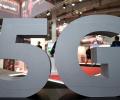
Bharti Airtel called the prices exorbitant while Vodafone Idea wants the auctions take place in 2020. The auctions need to happen when the infrastructure is ready for the roll out, be it in terms of fiberisation levels, or optimisation of equipment and software etc. Spending a hefty amount on a technology (airwaves) that at present offers limited returns is not going to be a priority for the incumbent telcos.

It came as a surprise to all stakeholders - competing telecom companies (telcos), most analysts and even the government's internal projections on revenues from the 5G auctions. Reliance Jio disrupted all calculations by paying a stiff Rs 40,000 crore to buy 10 MHz of spectrum in the 700-MHz band, globally considered a key band for efficient 5G service coverage, along with the default 3.5 GHz band and the ultra-high speed and low-latency millimetre band of 26 GHz band. So what made Jio pay almost 45 per cent of its total spend in this auction for the 700 MHz band - much more than what it rustled up even for the 3.5 GHz band?

About 2,000 MHz will be put up for auction in bands such as 700 MHz, 800 MHz, 900 MHz, 1,800 MHz, 2,100 MHz, 2,300 MHz and 2,500 MHz

Enquiries indicate it belongs to an industrialist with links to a prominent cricketer.

Institutional investors led by foreign portfolio investors have bought these shares.

In its report 'Global Top Picks', Barclays expects the current bull market in global equities to continue, generating a total return of 9 per cent in 2015.

The merged entity would lead with a revenue market share of about 37 per cent against Airtel's 31.2 per cent and Jio's 14.5 per cent
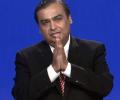
However, in the last few sessions, the stock of Mukesh Ambani-controlled Reliance Industries Limited (RIL), hit its 52-week low level of Rs 2269.75, and has been one of the worst performers among the Sensex pack thus far in calendar year 2023 (CY23). Thus far in CY23, RIL has tanked nearly 11 per cent as compared to a fall of around 5 per cent in the S&P BSE Sensex. The fall in the stock, according to Gaurang Shah, senior vice-president at Geojit Financial Services is mostly due to the overall dip in the market sentiment, which in turn has impacted large-caps, including RIL.
 © 2026 Rediff.com - Investor Information - Advertise with us - Disclaimer - Privacy Policy - Sitemap - Feedback - About us - Terms of use - Grievances